
Helicopter Instructor
Mastering the unstable.
A helicopter is unstable by nature, and much of flying one is feeling the tilt before the instruments show it. A fixed-base simulator cannot teach that. On a six-axis motion platform your students learn to feel the hover, manage the coupling and handle emergencies without risking a hull.
Feel the hover
Students struggle with the hover because they rely on their eyes, not their body. Stop teaching students to look for a tilt; teach them to feel it. The platform reproduces the small swinging movements of a hover on all six axes, and the seat carries them into the body.
Coupling you can feel
Every input touches another axis: raise the collective and the nose swings. On a fixed simulator the student only sees it. Here they feel it in the seat and learn to catch it with the pedals, so they over-correct less and understand the controls sooner.
The risky parts, first on the ground
Slope landings and a hover in gusts are risky in the aircraft, so novices meet them late. From the Instructor Station you set them up, and the student feels them in motion first. By the time they fly one for real, the sensation is familiar.
Spend the aircraft hour on what matters
A helicopter hour costs far more than a fixed-wing hour. Students can fail the hover and the landing here many times for the cost of one real flight, and spend the aircraft hour on high-value maneuvers instead of basic instability.
Fixed-wing vs helicopter
Motion focus
Fixed-wing instructor
Feel the turns and climbs.
Helicopter instructor
Feel the hover, tilt and instability.
Control logic
Fixed-wing instructor
Standard flight profiles.
Helicopter instructor
Complex coupling: cyclic, collective and pedals.
Emergency training
Fixed-wing instructor
Engine failure, unusual attitudes.
Helicopter instructor
Slope landings, gusts, a hover that gets away.
Learning curve
Fixed-wing instructor
Fewer repetitions in the air.
Helicopter instructor
Less over-correction, a stable hover sooner.
Sensation
Fixed-wing instructor
Authentic flight feel.
Helicopter instructor
Visceral, high-frequency instability.
Each helicopter's motion is calibrated flight state by flight state, together with a pilot who flies it.
“The hardest part of teaching the hover is not the theory, it is the feel. On the VXR-7 your students feel the coupling and build a seat-of-the-pants intuition before they touch the collective of a real aircraft.”
Read the full case
Unlike fixed-wing aircraft, helicopters are inherently unstable. A huge part of helicopter flight is seat-of-the-pants flying: sensing the tilt of the aircraft before it becomes visible on the instruments. Fixed-base simulators are almost useless for teaching these sensations, so a six-degree-of-freedom motion platform isn't a bonus, it is a pedagogical necessity. The VXR-7 bridges the gap between theoretical flight and visceral reality, teaching your students to feel the hover, manage coupling, and survive emergencies without risking a hull.
The sensation of the hover
The hardest part of helicopter training is the hover. Students often struggle because they rely too much on what they see and not enough on what they feel.
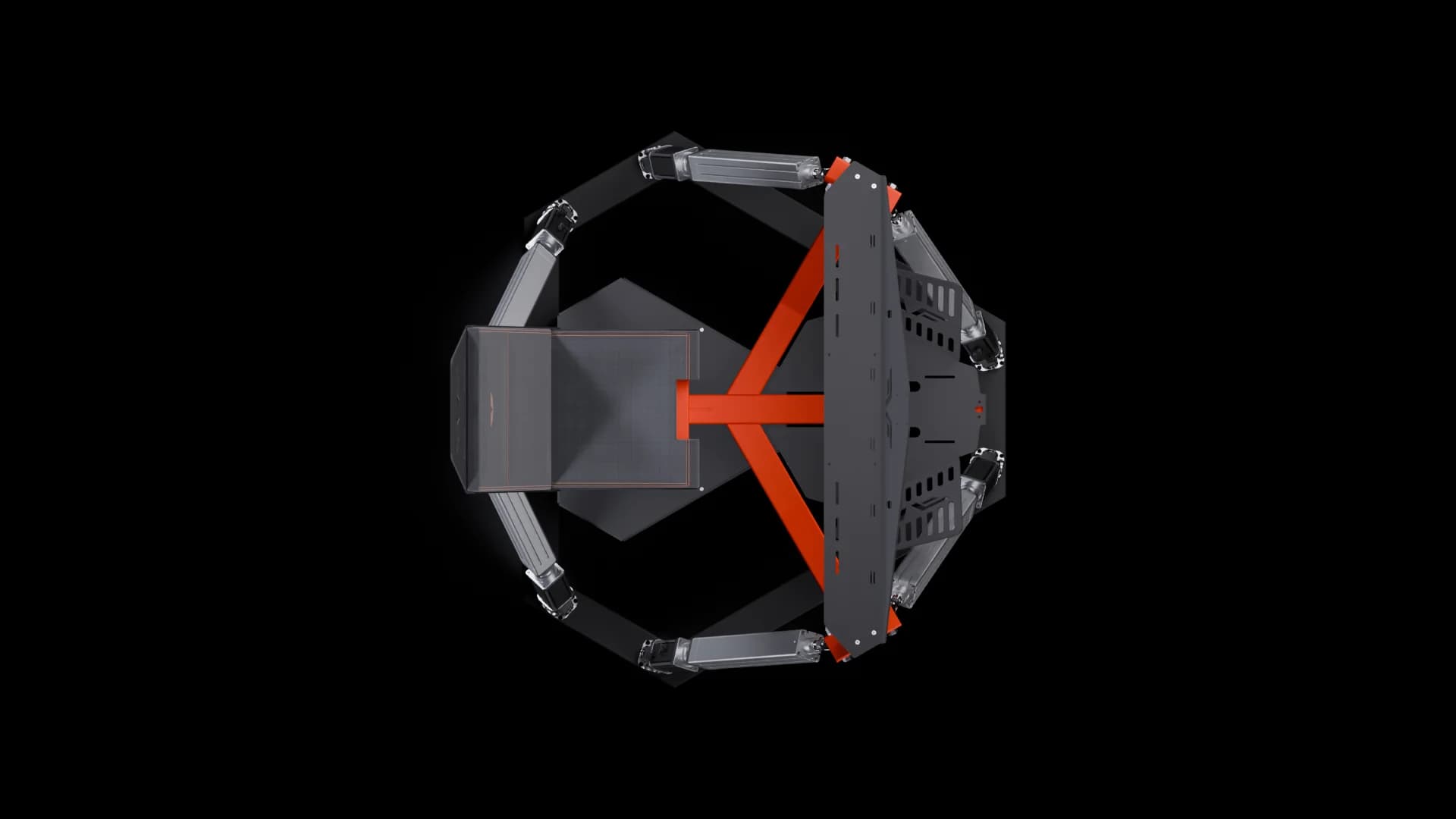
Stop teaching students to look for a tilt; teach them to feel it. The VXR-7's Stewart platform reproduces the subtle pendulous movements and instability of a helicopter in a hover across all six degrees of freedom. The seat carries these movements directly into the pilot's body, so students develop the instinctive corrections a stable hover demands before they ever leave the ground.
Managing complex coupling
In a helicopter, every input affects another axis: increasing collective changes the yaw. Learning this coupling is one of the most frustrating parts of early flight training.
With the platform position updated 1,000 times per second, the VXR-7 gives a physical answer to every control input. When a student raises collective, they feel the resulting motion. This tight feedback loop reduces over-correction and helps students internalize the relationship between the controls far faster than a fixed simulator allows.
Slope landings and gusts
Slope landings and a hover in gusts are risky in the aircraft, so novices meet them late.
From the Instructor Station you set them up, and the student feels them in motion first. By the time they fly one for real, the sensation is familiar.
The economics of rotorcraft training
Helicopter flight hours are significantly more expensive than fixed-wing hours due to maintenance and fuel costs.
Move repetition from the air to the motion platform: one simulator hour is a fraction of an aircraft hour, and for helicopter schools the ROI is even more dramatic. Students can fail at hovering or landing a hundred times for the cost of one real flight, ensuring that when they do fly, they perform high-value maneuvers instead of fighting basic instability.
“You know that the hardest part of teaching a student to hover isn't the theory, it's the ‘feel.’ For too long, simulators have been visual aids that ignore the physics of rotorcraft stability. The VXR-7 changes that. With Swiss six-degree-of-freedom precision, your students can finally feel the coupling and develop a true seat-of-the-pants intuition before they ever touch the collective in a real aircraft. Stop fighting the instability, start teaching it.”
Your VXR-7